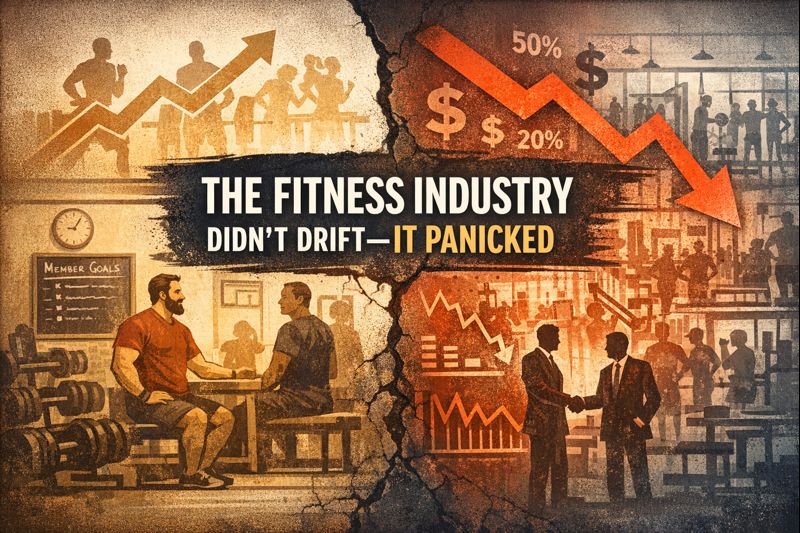
The Fitness Industry Didn’t Drift — It Panicked
The Fitness Industry Didn’t Drift - It Panicked
The fitness industry didn’t lose its way.
It didn’t forget its mission.
It didn’t suddenly stop caring about people.
It panicked.
That distinction matters, because drift suggests confusion, while panic explains behavior. Panic explains why an industry built to help people move, improve, and feel better gradually reorganized itself around volume, pricing tactics, and short-term survival.
This wasn’t a moral failure. It was a systems failure.
And systems behave predictably under fear.
When Fitness Was About People, Not Volume
Before fitness became an “industry,” it was small, unsophisticated, and deeply human.
Early clubs didn’t have refined sales processes or sophisticated metrics. They didn’t need them. Personal attention wasn’t a strategy...it was unavoidable. If someone walked in, you knew their name. If they stopped showing up, you noticed. If they were struggling, someone intervened.
Not because it was enlightened, but because scale hadn’t removed proximity yet.
The experience worked because it couldn’t scale.
Scale Changed the Rules...and Exposed a Flaw
As clubs grew larger, the math changed.
Bigger facilities meant higher fixed costs. Higher fixed costs required more members. More members demanded faster sales. Faster sales reduced the capacity for individualized attention.
The business scaled.
The experience didn’t.
At first, the mismatch was subtle. Clubs were opening successfully. Membership numbers looked healthy. Revenue climbed. But beneath the surface, something new appeared, something the industry wasn’t prepared for.
Mass attrition.
People joined, but they didn’t stay.
And worse, many didn’t even start.
The Panic Loop Begins
This is where panic quietly took over.
Not all at once, but in a loop that still exists today:
Membership volume increases
Attrition appears unexpectedly and at scale
Pressure mounts to replace lost members
Sales intensity increases
Retention is discussed, but not operationalized
Price becomes the lever
Value erodes
The loop repeats
Retention wasn’t ignored.
It was acknowledged and then sidelined.
Not because it didn’t matter, but because it didn’t scale.
The Lie That Kept the System Alive
To survive, the industry told itself a lie:
If we sell more, the problem goes away. (...and my drink just blew out my nose as I typed this line - because I've heard this too many times by executives to count)
For a while, it worked.
Revenue masked dissatisfaction. Growth hid disengagement. Math replaced meaning. Clubs learned how to out-sell churn rather than eliminate it. Sales volume became the anesthetic.
But you can’t outsell disengagement forever.
Eventually, price wars began. Commitments shortened. Contracts softened. Differentiation collapsed. The product became interchangeable and the customer became transactional.
The Question We Never Asked (But Should Have)
The industry kept asking the wrong question.
Not:
How do we sell more memberships?
But:
Why don’t people stay?
Why don’t most people start?
Why does effort so often fail to produce results?
These weren’t motivational problems.
They were design problems.
Fitness optimized for transactions instead of outcomes. Attendance instead of progress. Access instead of guidance.
People were given equipment - but not direction.
Choice - but not clarity.
Freedom - but not support.
And when results didn’t come, the burden quietly shifted onto the individual.
This Wasn’t a Moral Failure...It Was a Systems Failure
Operators weren’t greedy.
Staff weren’t careless.
Owners weren’t blind.
They were trapped inside systems that made real personalization impossible at scale.
You can’t deliver individualized guidance to hundreds of new members a day with labor alone. You can’t expect results without structure. You can’t ask humans to succeed inside systems that require expert-level self-direction.
Motivation doesn’t fix broken systems.
What the Panic Cost Us
Over time, the consequences became normalized.
The “20% ceiling” became accepted as inevitable.
The other 80% stopped being part of the conversation.
Fitness became intimidating, confusing, optional.
Results became accidental instead of expected.
The industry didn’t just lose people. It lost trust.
Not because people don’t want to get better.
But because they stopped believing the system would help them do it.
The Way Forward Starts With a Different Question
The future of fitness won’t be unlocked by louder sales scripts, clever pricing, or trend-driven marketing.
It begins with a different question:
How do we help people reliably get better?
Not occasionally.
Not accidentally.
But intentionally - at scale.
That question doesn’t point to a tactic.
It points to a redesign.
Systems Can Be Rebuilt
Panic built the current model.
Intention won’t fix it.
Systems will.
The next era of fitness won’t be led by those who sell harder but by those who design environments where progress is expected, guidance is scaled, and outcomes are no longer optional.
Fitness didn’t drift.
It panicked.
And now it has a chance to rebuild...on purpose.